
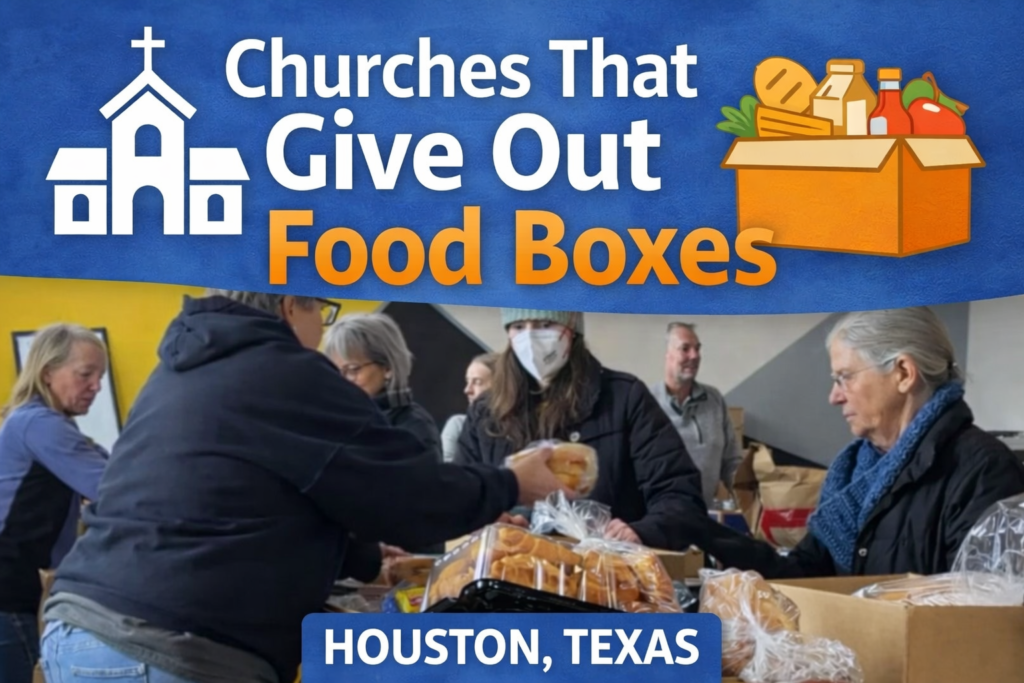
Many local churches and faith-based humanitarian networks distribute free food boxes to individuals and families experiencing food insecurity. Typically, these boxes contain staples such as canned goods, cereal, and pasta, and sometimes fresh produce, meat, or dairy products.
Since food distribution is managed locally, the easiest way to find a nearby church is to check major national faith-based networks or use specialized search tools.
Nationwide Church Networks That Offer Food Boxes
The Salvation Army
The Salvation Army provides free, nutritionally balanced food boxes to individuals and families facing emergency food insecurity. Typically, these boxes contain a three- to five-day supply of items such as canned proteins, vegetables, pasta, and grains—along with fresh meat, dairy, and fresh produce when available.
Because each local branch (known as a “Corps”) operates independently, hours of operation, box contents, and specific access rules vary by location.
What types of food programs are offered?
Emergency food boxes: Pre-packed boxes containing non-perishable staples, canned goods, and grains, designed to supply a household for several days.
Food packages: Smaller, pre-packed bags for individuals with limited mobility, providing enough food for two or three specific meals per week.
Mobile pantries: Trucks that travel along scheduled routes to deliver food boxes directly to areas lacking a physical distribution center.
Food boxes for seniors (Commodity Senior Food Program): Boxes specifically designed with nutritious, low-sodium foods, distributed monthly to eligible low-income seniors.
General guidelines and eligibility requirements
Frequency restrictions: Most centers allow requests for an emergency food box once every 30 or 60 days to ensure there are enough supplies for the entire community.
Income requirements: Proof of low income is not required for standard emergency food boxes; the service is based on immediate crisis situations.
Basic documentation: While the goal is to serve everyone, most physical centers require photo identification from the adult picking up the food. They may also request a recent utility bill or piece of mail as proof of residency to confirm that you live within the service area assigned to your zip code.
How to Get Your Food Box
Find your nearest location: Use the official Salvation Army food bank portal and enter your zip code to get the address of the closest service center.
Check the schedule: Do not show up without notice. Many centers distribute boxes only on specific days (such as Tuesdays and Thursdays) and during limited morning or afternoon time slots.
Call ahead: Some centers require you to call a few hours in advance to reserve a box for the day so they can prepare it beforehand.
Catholic Charities
Catholic Charities offers free emergency food boxes to individuals and families experiencing food insecurity, regardless of religious beliefs. These boxes typically contain a three- to five-day supply of basic non-perishable items—such as canned protein, pasta, rice, and cereal—and are often supplemented with fresh produce, dairy, or meat, depending on local donations.
Since services are organized by local dioceses, distribution models, schedules, and specific requirements vary by community.
Types of food assistance programs
Choice-based food banks: Some centers operate like a small grocery store where you can select the specific items to include in your food box based on your family’s dietary needs.
Drive-thru or mobile distribution: Many centers organize contactless events where volunteers load pre-packed food boxes directly into your vehicle’s trunk.
Emergency food packages: Rapid-response boxes designed to provide immediate, short-term crisis relief when an individual or family has run out of food.
Home delivery services: Specialized programs that bring food boxes directly to the homes of homebound seniors, people with disabilities, or those without transportation.
General Requirements and What to Bring
Open to all: You do not need to be Catholic to receive help. Programs are open to anyone in need within the service area.
Photo ID: Most centers ask the head of the household to present a basic photo ID (such as a driver’s license or state ID) during the initial registration process.
Proof of residence: You may be asked to show a recent utility bill, lease agreement, or piece of mail to confirm that you live within the county or specific zip codes served by that local location.
Household information: Some centers request the names and dates of birth of everyone living in your household to ensure you receive a box of the appropriate size for your family.
How to receive a food box
Locate your center: Use the official Catholic Charities USA directory (“Find Help”) to find the agency serving your specific county or region.
Check distribution hours: Church-affiliated pantries often operate on limited days (such as specific weekday mornings) rather than following standard business hours.
Check registration rules: While many centers allow walk-ins, some high-demand locations require calling ahead or scheduling an appointment online to reserve a box.
Society of St. Vincent de Paul
The Society of St. Vincent de Paul (SVdP) offers free emergency food boxes to individuals and families facing food insecurity. These boxes contain basic non-perishable items—such as canned vegetables, soup, pasta, and beans—and are often supplemented with fresh bread, meat, or fresh produce.
Unlike many other charitable organizations, St. Vincent de Paul operates primarily through local church-linked groups (called “Conferences”), meaning the assistance is deeply rooted in your own neighborhood.
Types of food assistance programs
Emergency food boxes: Pre-packed boxes that are either delivered to your home or picked up at a parish pantry; …are designed to supply a household for several days.
Home delivery services: A distinctive feature of the SVdP, where volunteers (known as Vincentians) bring food boxes directly to your door if you lack transportation or are unable to leave your home.
Parish food pantries: Pantries offering walk-up or drive-thru service, operating on the grounds of local Catholic churches on specific days of the week.
General requirements and what to bring
No religious affiliation required: The Society of St. Vincent de Paul (SVdP) serves anyone in need, regardless of religion, race, or background.
Proof of residence: Since local groups (known as “conferences”) serve specific geographic areas—usually tied to parish boundaries—you will likely need a utility bill or piece of mail proving you live within their service area.
Identification: Basic photo identification for the primary recipient is usually requested during the registration process.
Home visit: If you are requesting home delivery or financial assistance, two volunteers may schedule a brief, compassionate home visit to deliver a food box and assess whether you need additional help with rent or utilities.
How to get your food box
Contact a local parish: Find the Catholic church nearest your home and call its office. Ask if they have an active Society of St. Vincent de Paul conference.
Call the local SVdP council: Most major cities have a central Society of St. Vincent de Paul helpline that routes your request directly to the neighborhood volunteers assigned to your zip code.
Check pantry hours: If you plan to visit a parish pantry in person, call ahead to verify distribution times, as many operate for only a few hours each week.
Local Baptist, Methodist, and Lutheran churches
Local Baptist, Methodist, and Lutheran churches form the backbone of community food assistance in the United States. Rather than operating as large, centralized charities, these individual congregations manage neighborhood-level food pantries and clothing distribution centers to serve their immediate local area or zip code. Since they rely heavily on local volunteers and regional food banks, their schedules are very specific, and they often operate only one or two days a week.
Types of food programs offered
Emergency food boxes: Boxes containing a variety of canned proteins, grains, cereals, and dry goods, designed to feed a family for a period of 3 to 7 days.
Community meals and hot meals: Many Methodist and Lutheran churches host weekly community dinners or Saturday breakfasts, in addition to their food box distribution services.
“Blessing boxes” / Outdoor pantries: Small, weather-resistant wooden cabinets located outside the church building. They remain unlocked 24 hours a day, 7 days a week, allowing anyone to take non-perishable food or leave donations anonymously.
Denominational Networks & Programs
Baptist churches: Often affiliated with the Southern Baptist Convention or regional Baptist associations, these churches frequently run large “benevolence ministries” or food and clothing banks out of their community halls.
United Methodist Churches (UMC): Known for their social outreach, many Methodist churches collaborate directly with regional Feeding America networks to serve as official neighborhood distribution centers.
Lutheran churches (ELCA / LCMS): Many Lutheran congregations run food banks under the umbrella of Lutheran Social Services (LSS) or operate independent parish pantries focused on helping local seniors and low-income families.
General rules and expectations
Zip code restrictions: Since independent churches have limited budgets, they often restrict food box distribution to residents living within specific zip codes or school districts.
Declaration of need: Unlike government programs, most church-run food banks do not require proof of income or tax documents. They rely on a “declaration of need”—meaning that if you state you need food, they will provide it.
Basic registration: You will generally be asked to fill out a brief form with your name, address, and the number of adults and children in your household so they can provide a box of the appropriate size. Bring a photo ID and a recent letter or bill (proof of address) just in case.
How to find participating churches near you
Check local church websites: Search online for nearby Baptist, Methodist, or Lutheran churches and look for tabs labeled “Ministries,” “Outreach,” “Community,” or “Benevolence.”
Use the 211 directory: If a church operates an official, authorized food bank, it will list its hours on 211.org. You can call 2-1-1 for a complete list of church-based food pantries open today.
How to find a food box distribution program near you
Use food pantry locators: Regional food banks supply local churches. You can enter your zip code into the Feeding America local food pantry search tool to view a map and list of all church-based food pantries in your immediate area.
Call 2-1-1: Dialing 2-1-1 (or visiting 211.org) connects you with a local community resource specialist who can provide information on the exact times and locations of churches distributing food today.
Search “FindHelp”: The FindHelp.org portal allows you to search for “food pantries” by zip code to check documentation requirements and specific service areas for local faith-based ministries.
What to expect (documents and requirements)
No questions asked: Many church-run programs operate under a “no questions asked” policy, meaning anyone who shows up can receive food.
Basic ID / Proof of residence: Some centers may request basic identification or a piece of mail (such as a bill or letter) to verify that you reside in the relevant service area or zip code. Proof of income is rarely required to receive emergency assistance boxes.
Drive-thru service vs. walk-up service: Many churches use a drive-thru distribution system, where you remain in your car while volunteers place pre-packed boxes into your trunk.

- Church Assistance Programs in Riverside County, CA - October 5, 2026
- Church Assistance Programs in Prince George’s County - October 2, 2026
- Church Assistance Programs in Philadelphia - October 1, 2026

